

It all started during a visit to a restaurant in Kolda, a place I frequent. There, I met a man who told me he raised sheep, and I asked him what he did with the manure. He said he threw it away. I asked if I could have some for myself, as I mentor market gardeners in Saré Djoubel, and the manure could be very useful for enriching their soil. He agreed and suggested I come and collect the manure; otherwise, he would have thrown it in the trash. I immediately called Mr. Korca, the manager of the Saré Djoubel farm, and we arranged a date for the manure collection.
On the day of the collection, we were lucky because Mr. Georges from the Ministry of Youth, a project partner, was on a mission in Kolda. Together, we collected the manure with his pickup truck and transported it to the Saré Djoubel farm. In total, we collected about ten bags of manure, each weighing approximately 50 kg. Before leaving the farm, I asked Mr. Korca not to apply it without me present, as I needed to explain the correct application method to ensure optimal soil and plant health.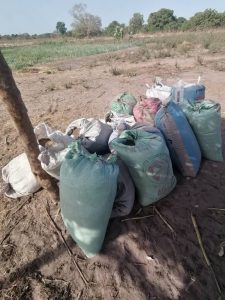
Applying organic fertilizer in the form of manure is very important. Normally, after preparing the soil for transplanting following the nursery stage, organic fertilizer, which can be in the form of manure, should be applied. Start by thoroughly turning the soil with a rake to ensure good mixing, and then mark out the planting rows. When transplanting, let’s take onions as an example. It’s important to maintain a spacing of 15-25 cm between rows and 10-15 cm between plants.
For onions, transplant when the seedlings have 3 to 6 leaves in the nursery. The nursery period for onions is estimated at 40-50 days.
In the Kolda market, there is a very good compound fertilizer called Triple 15, containing 15% nitrogen, 15% phosphorus, and 15% potassium. This fertilizer is suitable for all soil types, but initially, we decided to apply manure.
After applying organic fertilizer in the form of manure, mineral fertilizer is applied during the growing season, respecting the application rate.
Let’s talk a little about weeding and hoeing at this stage of our process: Weeding and hoeing are essential techniques for maintaining fields, gardens, or vegetable patches.
- Weeding: This operation consists of removing weeds growing around cultivated plants. Weeding can be done by hand or with tools like a hoe. It helps reduce competition between cultivated plants and weeds for nutrients and water.
- Hoeing: Hoeing involves loosening the soil around plants to prevent compaction caused by frequent watering or rain. This technique allows moisture to rise to the surface, thus preventing roots from rotting. Hoeing also helps aerate the soil and promote plant growth.
These two techniques are often used together to maintain healthy plants and optimize their development.
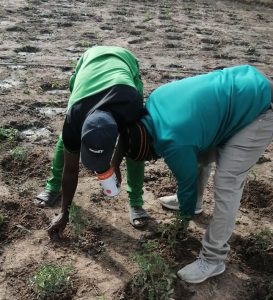 It is important to weed and hoe at the right time, as this keeps the plots clean and promotes healthy plant and bulb development. Onions are very susceptible to weeds, especially in the first few months of growth. Regular weeding is therefore necessary to aerate the soil and reduce competition for water and nutrients with weeds. Furthermore, weeding helps keep the plots clean, preventing weeds from competing for nutrients with the crops. When a plot is very weedy, plants do not benefit from the nutrients because weeds take over, to the detriment of the vegetables or other plants.
Onions are very sensitive to excess water and humidity. Among the different varieties (white, pink, yellow, and purple), the purple variety grown in Saré Djoubel is particularly vulnerable. Although pink onions are more resistant to excess water, it is crucial not to flood the plots, as this can cause cracking and rot in the developing bulbs. With this advice, the farmers at the Saré Djoubel farm are getting to work, expecting significant results in 150 days.
Moïse Tchomguia, volunteer in Kolda, Senegal